

The ClearTech Guide to Evaluating an Audiovisual (AV) Vendor Partner December 2025

A Tool for Decision Makers

The quality of your partner relationships bears directly on the success of your business. So, what can you do to ensure you make the right decision in selecting an AV solutions provider? The ClearTech Guide to Evaluating an Audiovisual (AV) Vendor Partner will make the process a whole lot easier.
Divided into three sections – Capabilities, Service, and Culture & Community – the Guide provides a framework for you to make the best decision for our business. You can read it here or download the guide as a PDF to share with your colleagues.
How to Assess a Current or Potential AV Vendor
Compatibility is key
Like any good relationship, a successful client-AV vendor partnership needs to be grounded in trust, clarity and collaboration.
Both parties’ goals, expectations, constraints and concerns must be openly shared. The client needs to trust that the AV vendor will recommend solutions in the client’s best interest, while the integrator trusts the client to provide honest feedback, timely decisions, and realistic information about needs and budget.
IT is an especially important component in establishing a shared vision of outcomes – an understanding of the “why” behind the work. Client and AV vendor should have a mutual understanding of what the technology integration is meant to achieve, and how it fits into the client’s larger strategic objectives.
So how should you evaluate a prospective integrator or determine the value you’ve received from your current partner?
We at ClearTech have conducted a deep dive into our client relationships – present and past – and identified key evaluation criteria, which we present in three sections: Capabilities, Service, and Culture & Community.
Ask the questions – and don’t stop asking until you achieve a clear understanding of precisely what you can expect from the integrators you’re considering.
SECTION 1:
CAPABILITIES
Does your prospective integrator partner have the resources, organizational structure and expertise to deliver for you?
This is a key question, and to answer it you’ll want to take a close look at your candidate’s capabilities and track record. By examining them in light of your current and projected needs, you’ll clear an essential hurdle in the evaluation process. Note, you’ll be well-served by looking beyond the integrator’s size. It’s understandable to assume that the larger the organization, the greater their capabilities will be. But are those capabilities relevant to YOUR needs? Will they be directed to advance your unique objectives? An industry behemoth might have global reach, but that’s not important if they don’t have the resources in place to provide precisely what you need, when and where you need it.
OVERALL CAPABILITIES
You need a partner with a PROGRAM
Your integrator partner shouldn’t look at your relationship as a series of projects, but rather as a unified program. What’s the difference between the two?
It’s about taking a systematic, holistic approach and developing a unified program. While creating, integrating, and servicing our AV solutions, we’re constantly assessing the big picture – looking for ways to meet our clients’ needs more efficiently, noting how key stakeholders prefer to interact with us, optimizing our accessibility, monitoring the supply chain to minimize or avoid the obstacles that come with complex installations, and establishing and reinforcing the partner relationships necessary to provide the standard of client care we promise.
Here it’s also important to examine an integrator’s partner relationships. Large integrators may tell you that they can handle everything in-house. Smaller ones will acknowledge that they draw on partner resources. ClearTech, for example, is a member of the Edge network of AV product and solutions providers. Our participation in this network gives us access to vast labor and technical resources and is also a major reason that our pricing for equipment is competitive with AV integrators who sell at a higher volume than we do. When we purchase on our clients’ behalf, we’re not just a single business making a relatively small purchase – we’re part of a collective with significant manufacturer influence.
Similarly, we have a longstanding partnership with other solutions providers that have strengths in particular areas such as remote monitoring. Through them, we can offer capabilities such as a 24/7 VNOC for proactive support of your AV systems.
Ask about your prospective integrator partner’s
ABILITY TO MEET PROJECT DELIVERABLES
In large part, this comes down to process. And commitment.
We believe that when looking at project deliverables – scope, schedule, quality, and budget – some pointed questions are in order.
First, ask about scope and requirements.
- How are project details and expectations compiled and documented?
- How do you ensure that system design matches business objectives?
- How are change orders communicated and approved?
Many concerns about project deliverables have to do with project management and methodology – your integrator’s choice of project management framework, the skills and qualifications brought to bear by their project managers, how they coordinate across trades to prevent bottlenecks, and the project planning tools used for scheduling, resource allocation and reporting.
Look also at timelines and milestones – how they’re determined and adhered to, as well as paths of escalation when deadlines are at risk. Can the integrator share examples of how they’ve gotten delayed projects on track?
The integrator’s approach to budget and cost control warrants close examination, too.
- How are costs estimated and overruns guarded against?
- Is there transparency with line-item pricing and vendor costs?
- What’s the process for proactively identifying and mitigating cost risks?
In addition, consider the ways quality assurance and testing are handled, how communication and reporting is managed, issues surrounding risk & contingency planning, and the way handover and documentation is handled.
A key to avoiding holdups and snafus in project delivery involves working with a partner who truly understands your needs. To that end: It’s not just your integrator’s tech team that should be familiar with your needs and preferences. Their executive team, sales and admin staff, and project management should be in tune with how you work, including how you prefer to share and receive information, what’s important to you, and the best way to partner efficiently.
There are large integrators who promise a world of capabilities and services, but the questions one must ask are: How nimble and flexible are they to meet your unique requirements? And how much of an investment are they willing to make to really learn about your organization and dedicate people to you?
Ask about your prospective integrator partner’s
TECHNICAL REQUIREMENTS
Does the integrator truly understand what you need?

Insist on a technical team that has the expertise to address your needs systematically and comprehensively. It’s not enough for them to be well-rounded in audio, video, control and whole-room systems. Networking knowledge is a must-have.
You need to know if your prospective partner has the competence, infrastructure and track record to deliver a system that performs reliably, scales with your needs and integrates seamlessly with your IT environment. One thing to look for is certified expertise in the platforms you use. Also make sure they have the engineering depth to design, program and commission a system to your standards. In addition, they’ll need up-to-date knowledge of networked AV, security compliance and interoperability. All this is important in a corporate environment.
As far as infrastructure is concerned:
- Do they have dedicated project management and documentation workflows?
- Is their service and support structure capable of responding to enterprise-level issues?
- Are technicians and engineers in-house or subcontracted (Note, subcontracted expertise is fine if all parties work together closely and reliably)?
Also ask about their procurement and logistics capacity to deliver what you need, where and when you need it.
Consider, too, how well your current or prospective integrator partner aligns with your technical and operational standards, including AV/IT integration protocols, enterprise network policies, your documentation and testing standards, and commissioning and QA procedures. Your IT and facilities ecosystem is probably well-established. To ensure they can accommodate it, ask about past performance and request proof of it in the form of case studies, client references, sample drawings, and rack layouts or commissioning reports that demonstrate their professionalism.
We’re often asked about risk management and compliance. Security compliance, health and safety adherence as well as warranty / SLA / lifecycle support capabilities need to be looked at, too.
The ability to act quickly in accordance with your needs and technical requirements is paramount, especially if you engage in high-stakes activities that do not allow for AV downtime.
SECTION 2:
SERVICE
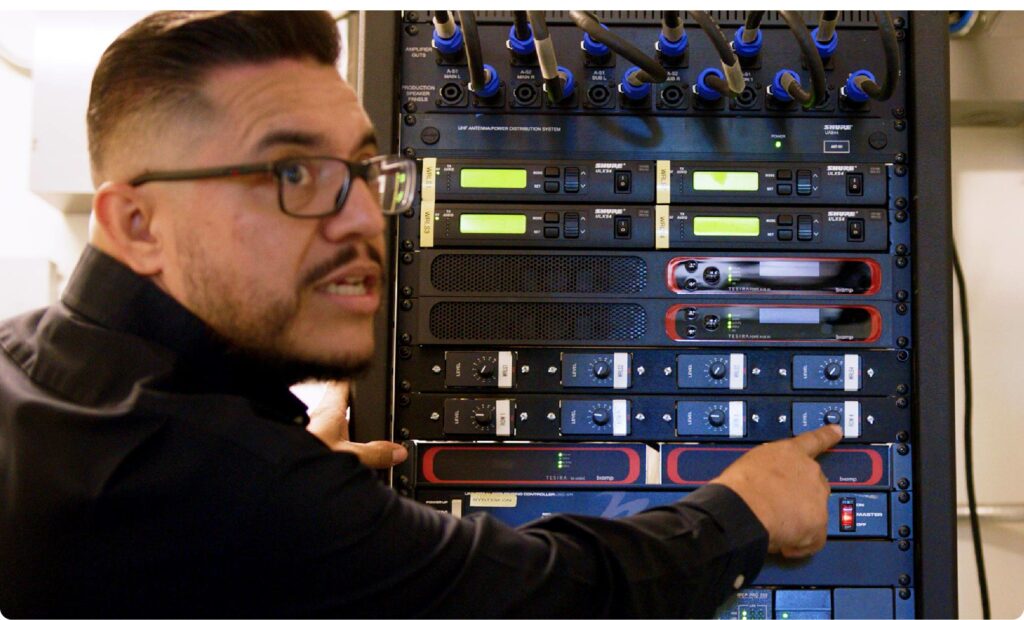
Does your prospective integrator partner have the people and processes in place to be responsive to your needs?
Multiple factors determine the value you receive from your AV solution. Project design, equipment and installation costs have to be considered closely, but they cannot be separated from an integrator’s ability to keep your solution performing day to day, for the long haul. Ultimately, value must be measured over the full solution life cycle. And over that span of time, the service you receive will be a determining factor regarding whether or not you get your money’s worth.
Ask your prospective integrator partner about
TOTAL COST OF OWNERSHIP
Every meeting moment matters
An AV infrastructure requires a significant financial investment – one that only begins with equipment procurement and integration. In determining the total cost of ownership, look at how well your solution will perform day in and day out, because you need uptime to be all the time.
That’s where service comes in. For our most demanding clients – enterprises with complex, rapidly evolving, mission-critical needs – we deploy full-time tech experts on site. They are solely devoted to ensuring that the client’s investment in their AV infrastructure pays off. Our team maximizes client ROI in multiple ways – first by conducting thorough, regularly scheduled preventative maintenance; and second, when equipment fails or users require assistance in optimizing equipment performance, by being on-site and on demand to get infrastructure and people back on track, ASAP.
Ask your potential partner if they have the capacity to really BE THERE for you. Will they “drop everything” to get you through a crisis? Will they take the time to understand how your organization works so that they can develop solutions that anticipate your needs and respond to them predictably and efficaciously?
One important criterion to consider is the longevity and stability of your integrator’s team. Is it subject to high turnover? Ask about average length of employment. Have them explain to you how they attract and retain the best staff. No matter how smart and dedicated an integrator’s team may be, there’s no substitute for consistency in staffing over time. You want a partner who knows your technical standards and workflows, and who has the quality of vendor and manufacturer relationships necessary to come through for you in a crisis.
The outcome is not only greater productivity for your people and organization. It’s a longer lifespan for your equipment and a correspondingly greater return on your investment.
By optimizing system performance and extending infrastructure life, your integrator partner will reduce waste and conserve resources – thus minimizing not only the cost to you, but to the environment itself by making your AV infrastructure more reliable, efficient and sustainable.
Ask about your prospective integrator partner’s
QUALITY AND SERVICE PERFORMANCE RECORD
Look at the numbers; ask for references
This is an important criterion. Fortunately, you have powerful ways to evaluate the quality and service you’ve received, or are likely to receive, from an integrator.
If you’ve been working with an integrator for a while and are assessing whether to extend the relationship, you’ve got plenty to work with already. Check their past performance – and be sure to solicit feedback from your facility managers, project managers, and end users who interact with the integrator most often.
If you’re considering a new partner, request references (and actually check them) and ask pointed questions about how quickly and fully they’ll respond to your needs and how much effort they’ve put into proactively maximizing uptime and facilitating operation of AV technology.
Again, this is an opportunity for you to take a closer look at your integrator’s culture, particularly their hiring practices. We believe very strongly that team members should be hired not just based on their credentials and technical proficiency, but for their reliability, responsibility and relentless determination to get to the root of a problem.
Ask your potential integrator partner:
- Have you established a company culture that empowers your team members to learn and advance in their careers and assume ever-greater responsibility?
- Do you reward them commensurately?
Our team is part of a family. That translates into greater employee retention (an average of 8 years in our case) and it also fosters a culture that makes our clients part of our family. You’ll see it in your team’s investment in your organization’s well-being and their commitment to your personal success as their chief client contact.
It’s important to highlight another factor that impacts an integrator’s quality and service performance record. Consistently great results and smooth performance owe in large part to the integrity of your partner’s AV integrations and the quality of AV equipment they specify. For example, we have cultivated a deep relationship with key providers such as Crestron and Shure such that we have an intimate knowledge of their products and direct access to their in-house expertise. That combination enables a level and consistency of performance that translates directly into client ROI.

Ask about your prospective integrator partner’s
ABILITY TO MEET YOUR SERVICE SPECIFICATIONS
Your partner needs to accommodate you, not vice versa
Most enterprises have developed their own service specifications that reflect the unique workflows, preferences and requirements that shape their organization. Insist that your integrator understand and abide by them. You might also ask them to review those specifications with an eye toward improving your systems and procedures. A competent, experienced integrator will almost certainly be able to offer valuable guidance in this regard.
We also believe it’s important to choose a partner who not only takes the time to understand your service requirements but takes a programmatic, process-driven approach to meeting them.
Think first about strategic fit and experience.
- Does your integrator have deep experience with an organization of your size and type?
- How do they ensure consistency of design standards and user experience across multi-site deployments?
It’s also important to look at design and standards.
- Does the integrator you’re considering follow enterprise AV standards (such as AVIXA guidelines, ITIL frameworks, or ISO standards)?
- How well do they align AV system design with your IT/security standards and infrastructure?
- How well do they collaborate to future-proof designs to accommodate scalability and new technologies?
You hire an integrator for their technology expertise – for AV systems that integrate seamlessly with enterprise IT, UC platforms and security policies – but you also need rock-solid project management and delivery, support and service, training and adoption offerings, and partnership and communication procedures.
This is what we mean by taking a programmatic approach to meeting your requirements. The right integrator partner will have thought through your service needs from every angle, and they’ll be ready to talk to you about their capabilities in each regard.
SECTION 3:
CULTURE & COMMUNITY

When looking for an integrator partner, think beyond the initial project or need. Your goal should be to seed a long-term relationship – one in which your integrator becomes a strategic partner; an ally who knows what you need and why you need it and understands both your immediate and future objectives. That kind of understanding will enable your integrator to truly optimize your communication and collaboration capabilities to realize your strategic vision.
Consequently, it’s important to take the time to get to know your prospective integrator partner’s foundational ethics and beliefs. They’re the basis of connection and trust. And when they match yours, you’ll be laying the foundation for a partnership that’s both efficacious financially and satisfying personally.
Ask about your prospective integrator partner’s commitment to
SOCIAL RESPONSIBILITY
More than ever, culture counts.
Any integrator can talk about culture. Not all of them practice what they preach.
Some integrators believe a commitment to social responsibility is a nice-to-have, but it’s not essential in a partner. Our belief is that scrutiny of how well a prospective integrator partner meets its social responsibilities tells you a lot about how well they’ll meet every other responsibility. That’s because it takes discipline and conviction to do the right thing. It requires a moral and ethical grounding that translates directly into how well your partner will mind your interests and have your back when the chips are down. Do they have a culture of doing the right thing, not just by their clients but their staff, stakeholders and neighbors as well?
We’ve created a culture with a bedrock conviction that our business does not operate in a vacuum. It can only be as healthy as the people, communities and planet that sustain us. To that end, we devote both time and resources to strengthening our ecosystems for the betterment of all. What does that mean specifically?
- We’re more than a company, we’re a family. Every team member is personally invested in one another’s success and that of our clients. We’re responsible for, and accountable to, one another. This results in a degree of connection that makes us not just a career destination for staff, but a sought-after partner for the organizations we serve.
- Our values reflect yours. As a woman-owned business with a team as diverse as it is capable, we nurture and exemplify the boundless potential of the American workforce. ClearTech mirrors the communities, organizations and industries we serve, and our status as an industry leader provides an example of what can be achieved when we create the conditions that allow individuals to thrive.
- What it means to be a Certified Women’s Business Enterprise. We have been a certified WBE through the Supplier Clearinghouse since 2012. It’s a credential that says we have the appropriate technical certifications, are licensed and bonded, and are operationally and financially sound. It’s an honor for us, and powerful reassurance for our clients.
- We contribute to our communities. Since the very beginning of ClearTech, we have been an active partner to community organizations on the front lines of addressing social, economic, and environmental issues. We donate AV equipment through the SAVe: A Second Life program, providing enormous benefit for local organizations in the vital work that they are involved in.
- We take sustainability seriously. Everyone talks about the importance of sustainability. ClearTech leadership founded the first and only U.S.-based, industrywide organization dedicated to bringing the 2030 Sustainable Development Goals to the pro AV industry. That organization, a registered 501(c)3 non-profit, is Sustainability in AV, or SAVe. ClearTech’s leadership team, including myself, CTO Joe Perez and VP of Operations Thuy To-Chin, have been instrumental in building SAVe and its initiatives that enable companies in the AV industry to establish sustainability plans, reuse and responsibly recycle AV equipment, and design and integrate sustainably.
What does all this mean for prospective clients? It tells them that we understand our responsibilities – to our clients and to our communities – and that we’re committed to meeting them.
If you share our belief that social responsibility is important, a partner like ClearTech will stand you in good stead. But even if your focus is exclusively on the bottom line, take note of your prospective partners’ commitment to goals and values that extend beyond the balance sheet. It will tell you something important about character and conviction – qualities that are essential to a healthy, long-term, profitable partnership.
Ask about your prospective integrator partner’s
ISNetworld RATING
Do they take safety seriously?
We’ve been an ISNetworld A-rated vendor since 2019 and have been in compliance with all its safety requirements such as our IIPP safety plans, insurance, and workers comp rating. Our record owes much to the culture we have established.
ClearTech’s workers comp mod (EMR) rating is .81. In fact, since our inception in 2009, we have had ZERO safety incidents. You don’t need us to tell you about the cost implications of safety incidents. They can be disastrous, so pay close attention to where your prospective integrator lands in this regard.
- A rating of 1.00 is the industry average.
- Below 1.00 is better than average.
- Above 1.00 is cause for concern.
We’re proud of how low our mod rating is, but it’s no better than what our clients – or you – should expect in an integrator partner.
Why is our safety record so good? Because we have created the systems – and created a culture – that takes safety seriously. ClearTech’s apprenticeship program, in place since day, ensures that our techs are always scheduled in pairs, with a lead and a junior. Moreover, it doesn’t matter what level of employee we hire. How senior they were in their last position is irrelevant. Anyone who comes to work for us as a new team member will work first as a shadow. They will learn safety as those practices are laid out in our IIPP plan and employee handbook.
As much as service is a part of our culture, safety comes first – always, every time. So when you’re evaluating an integrator, look closely at EMR. Moreover, as part of your investigation, review trends over time. At minimum, review three-year trends to ensure an integrator’s rating isn’t worsening. Also, ask for supporting documentation for OSHA logs, TRIR and DART rates alongside your EMR.
A Final Note…
Careful consideration pays off.
You have a lot riding on your choice of audiovisual solutions provider. AV systems are essential workplace infrastructure. They need to work every time. They must integrate clearly with IT networks and security. And they’ve got to be flexible and scalable in the face of constantly changing technology and an enterprise’s ever-evolving strategies. The downtime, frustration and fragmented user experience resulting from a poorly functioning AV infrastructure need to be minimized for an organization to thrive.
So don’t be afraid to ask questions – and don’t hesitate with follow-ups. A prospective partner will understand your thoroughness and won’t attempt to pressure you into deciding before you’ve thought everything through.
If an integrator candidate provides blanket assurances without taking the time to back them up, or if they won’t provide references, that’s a red flag. You should also expect them to have questions for YOU. After all, it’s in both parties’ interest to establish the foundation for a longstanding relationship. The more they know about your needs and objectives, the greater the likelihood of a fruitful ongoing partnership.
We invite you to speak with us about your goals and requirements for an integrator. Please feel free to reach out to ClearTech to schedule a call or meeting. We’re eager to connect!
